Hair and beauty salons once filled their books through location, word-of-mouth, and local reputation alone. That era is over. Market saturation, the rise of independent suite operators, and shifting search behavior have made paid digital acquisition a core driver of salon growth — and Google Ads sits at the center of it. But running ads without a quantitative framework is how salons lose money. This guide shows exactly how to size your budget, calculate what a client is worth, and build campaigns that compound over time.
1. The Economics of Search Advertising in Beauty
Search advertising captures consumers at peak transactional intent — a moment social platforms can't reliably replicate. But the beauty and personal care sector is becoming more expensive to compete in, demanding a more analytical approach to campaign investment. .
Over the past two years, the average cost per click in the sector has surged sharply, while click-through rates have compressed — a sign of rising SERP competition from franchise networks, direct-to-consumer brands, and independent suite operators all bidding for the same local keywords.
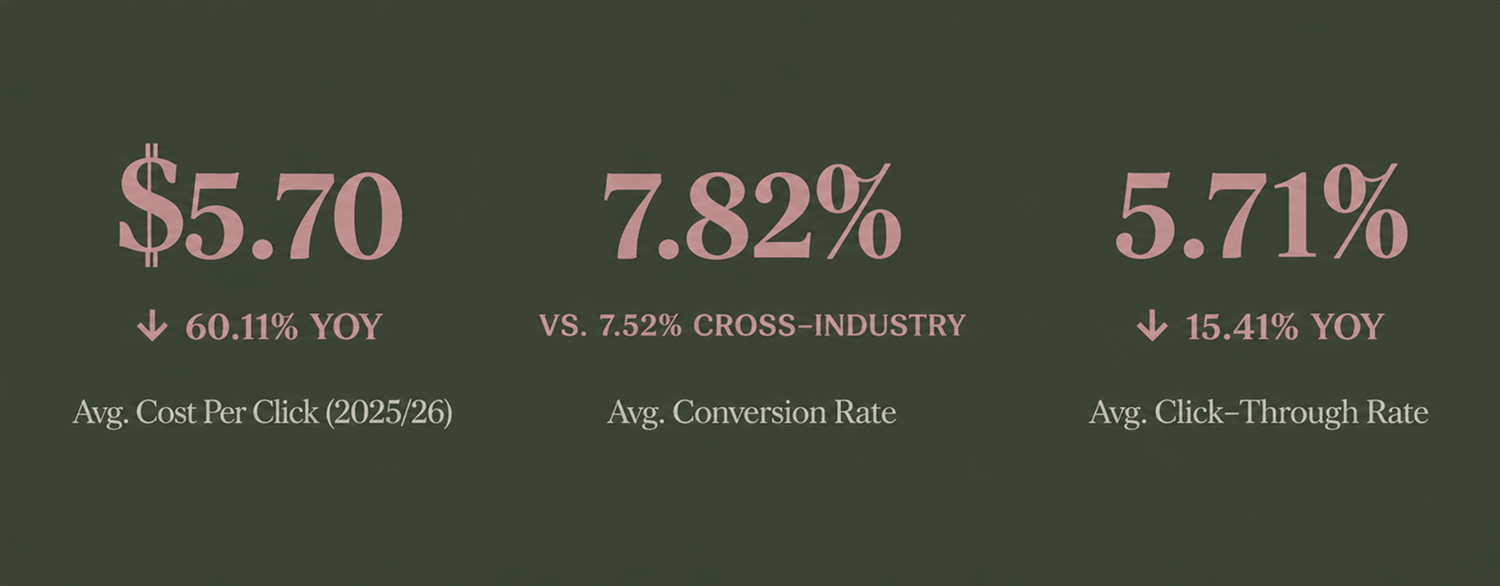
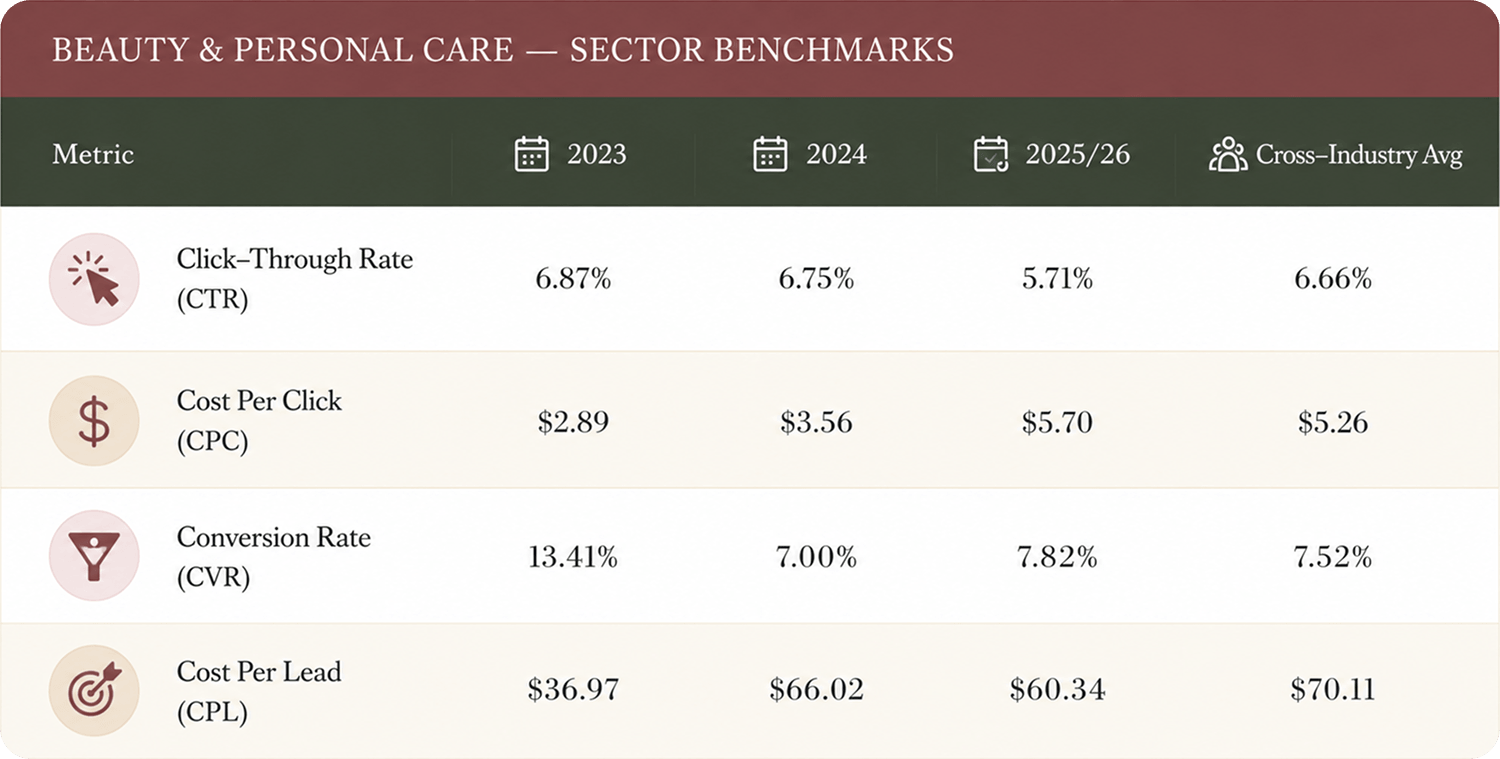
Key insight: Despite rising CPCs, conversion rates remain resilient. When users click a salon ad, they intend to book — making search campaigns highly efficient at capturing demand that social media can only approximate.
2. Three Budget Modeling Frameworks
There is no single correct ad budget — there is only a budget that's correct for your revenue, your market, and your unit economics. The three frameworks below give you different angles on the same question.
Framework 1 — Revenue-Based Allocation
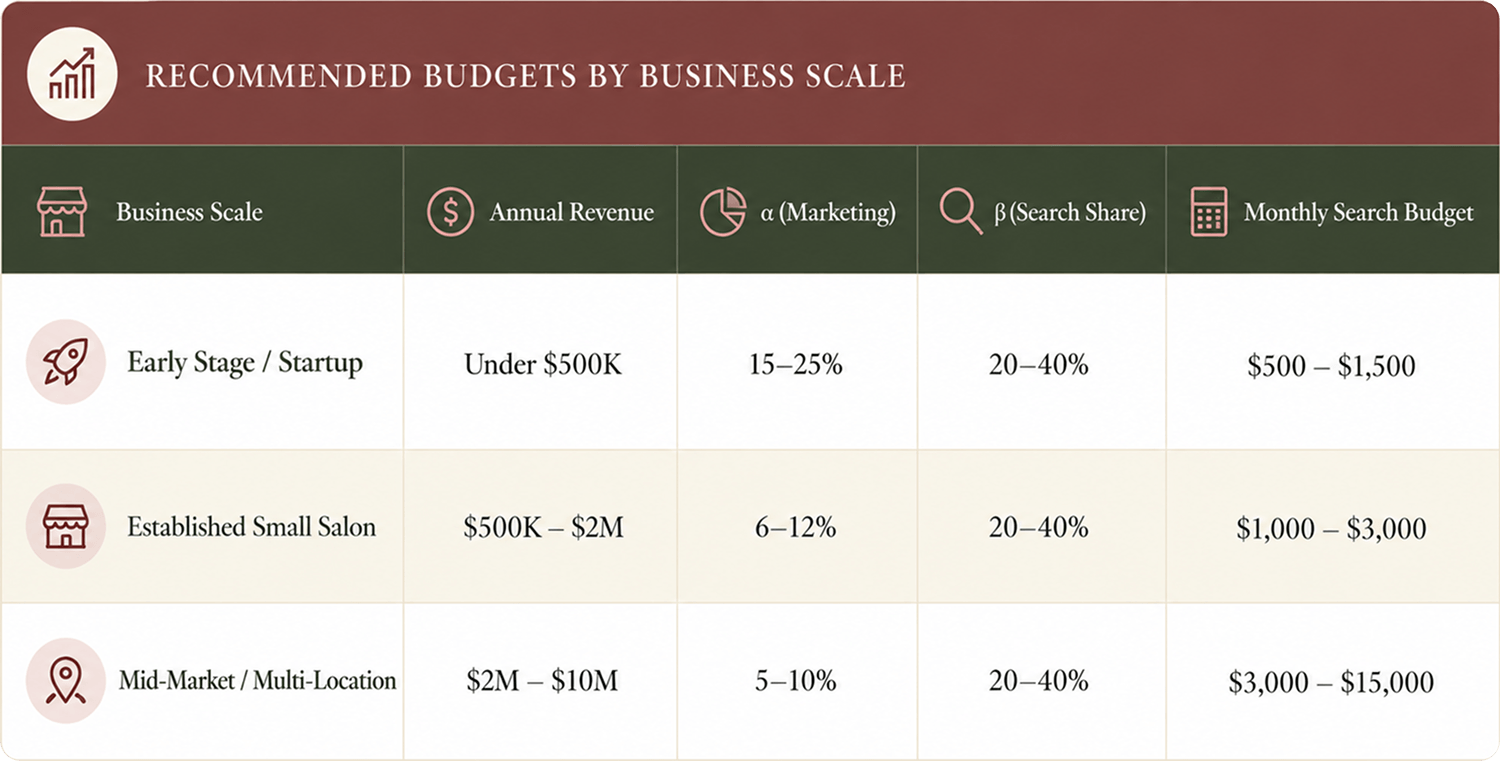
This top-down model treats marketing as a percentage of gross revenue, then allocates a channel share to
search.
Applied example: a salon earning $50,000/month uses α = 0.07 → M = $3,500. At β = 0.30 → Google Ads budget = $1,050/month.
Framework 2 — Daily Click Volume Requirement
Google's machine-learning algorithms need a minimum data feed to optimize. A $10/day budget at $5.70 CPC generates ~1.75 clicks daily — far too thin for the algorithm to learn.
Compressed quarterly strategy: Instead of spreading $12,000 over a year ($1,000/month), consolidate into one high-intensity quarter at $4,000/month. This approach wins better auctions, builds optimization data faster, and tests channel viability in a meaningful window.
3. Customer Lifetime Value & Acquisition Cost
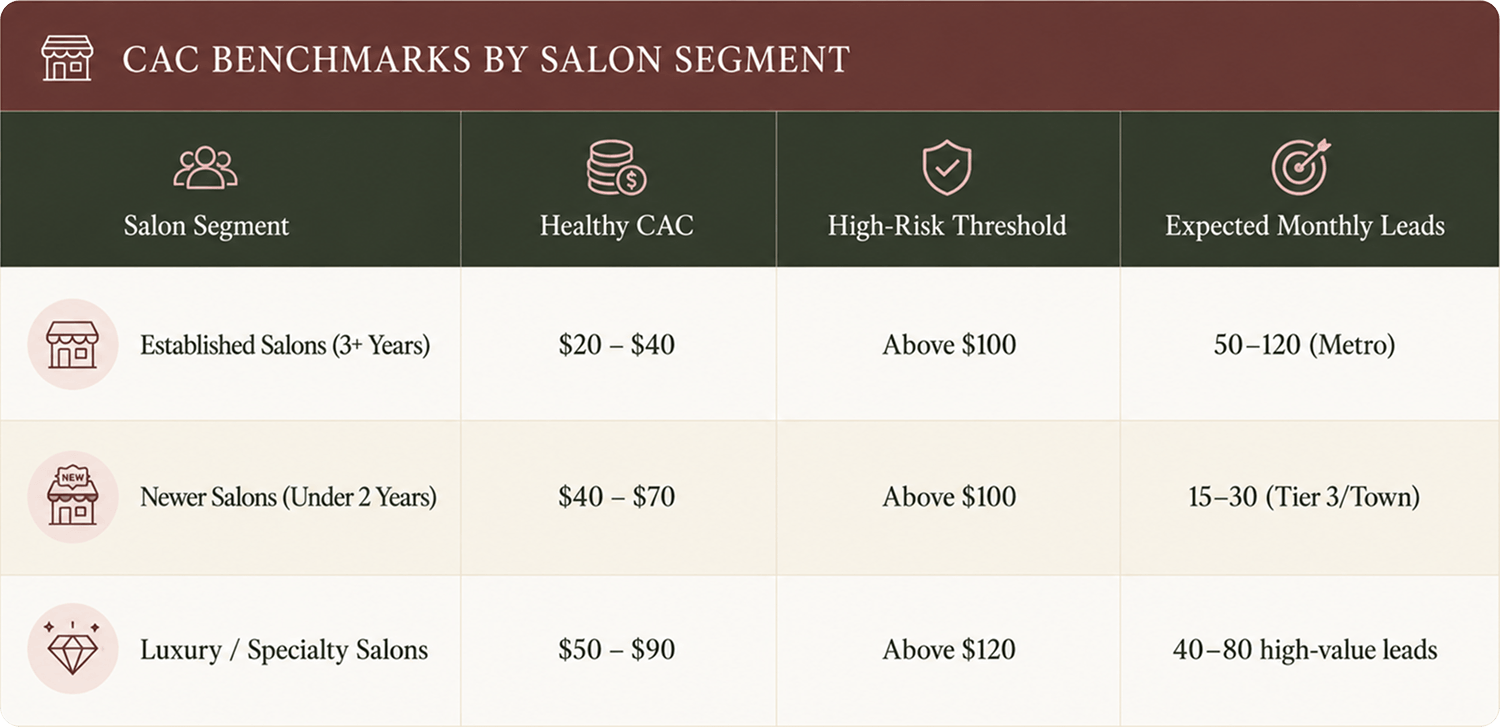
Any acquisition spend must be anchored to the long-term value of the customer it's buying. In the salon industry, where retention drives profitability, ad spend must be governed by the relationship between LTV and CAC
4. Manual Bidding vs. AI-Optimized Campaigns
The bidding infrastructure you choose determines your cost-per-booking as much as your budget does. Campaigns using Google's machine-learning Smart Bidding consistently outperform manually managed accounts across every key metric
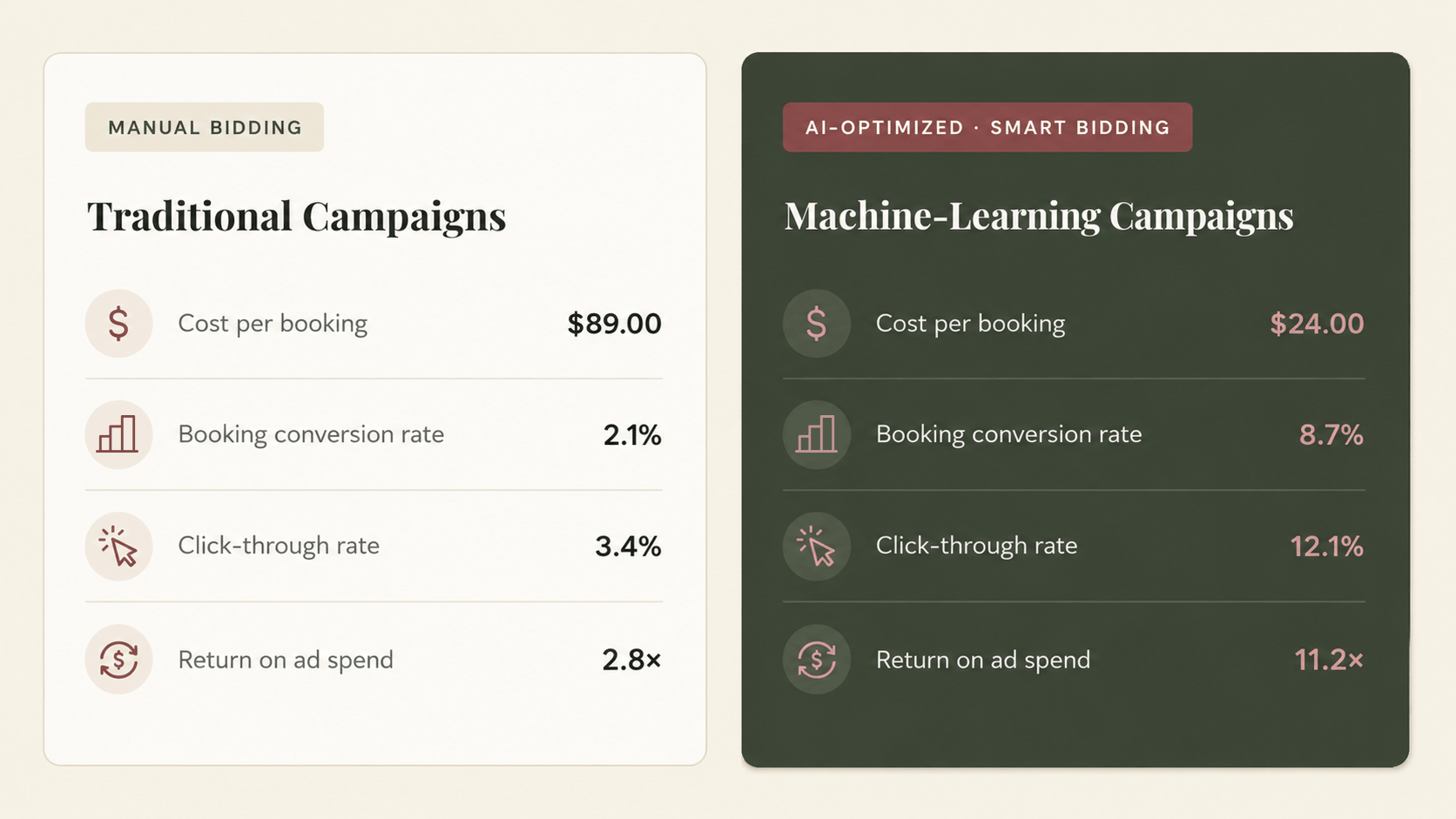
The gains are driven by real-time contextual signals — bid adjustments for users who have browsed highintent pages, lower bids during historically low-conversion hours, and device-level intent modelling that no human manager can replicate manually.
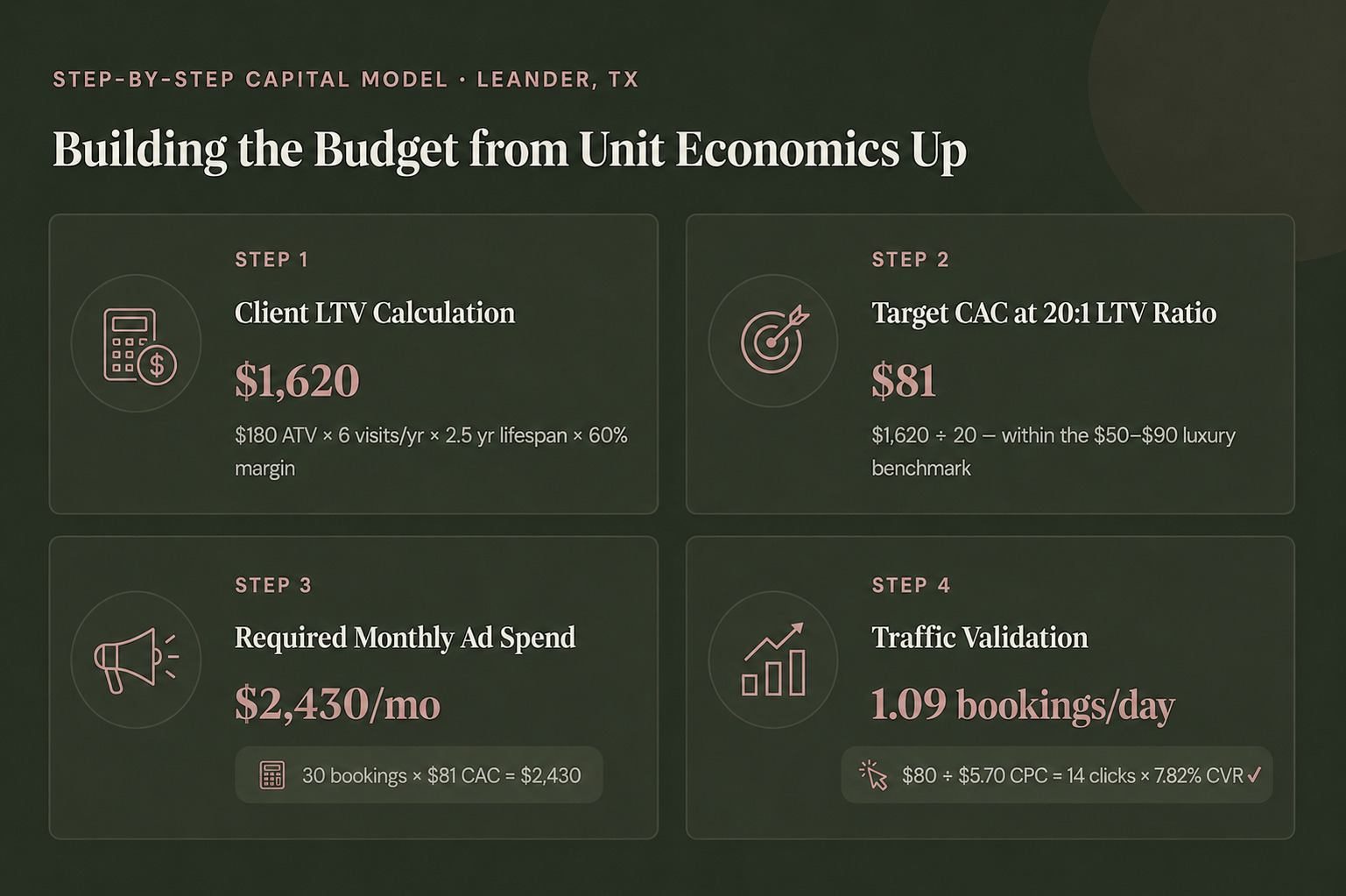
5.Case Study: Leander, Texas
To see how these formulas work in practice, consider a premium salon in Leander, TX — a fast-growing,
high-income suburb north of Austin with a median household income of
6.Campaign Architecture & Waste Prevention
The average unmanaged Google Ads account wastes $1,127/month — roughly $3,383 per quarter — through structural inefficiency. The most common error: grouping all services into one campaign, letting low-ticket services consume budget meant for high-margin bookings .
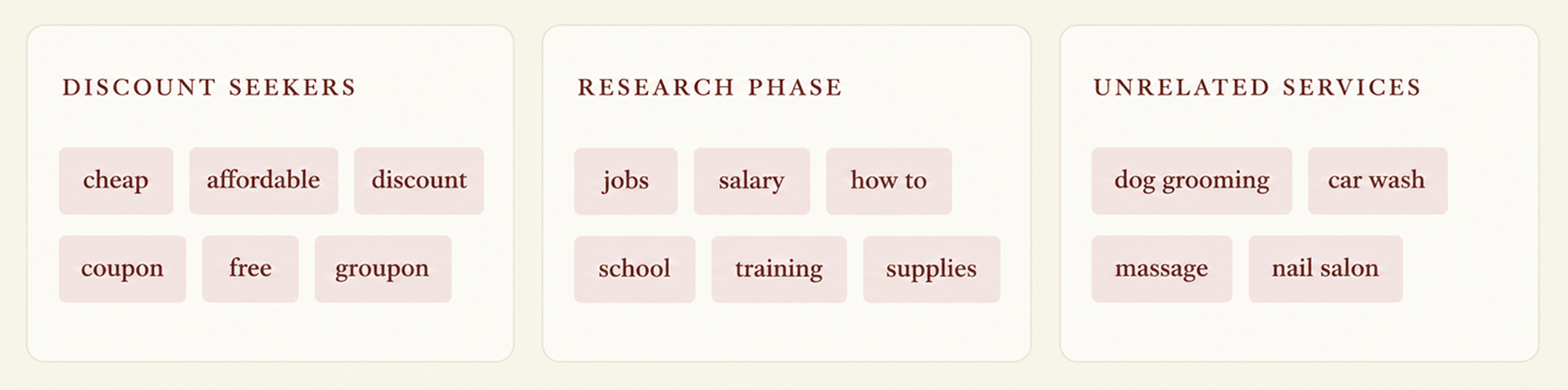
Negative keyword infrastructure is non-negotiable. Three categories to exclude from day one:
Recommended budget phasing — build momentum before scaling aggressively:
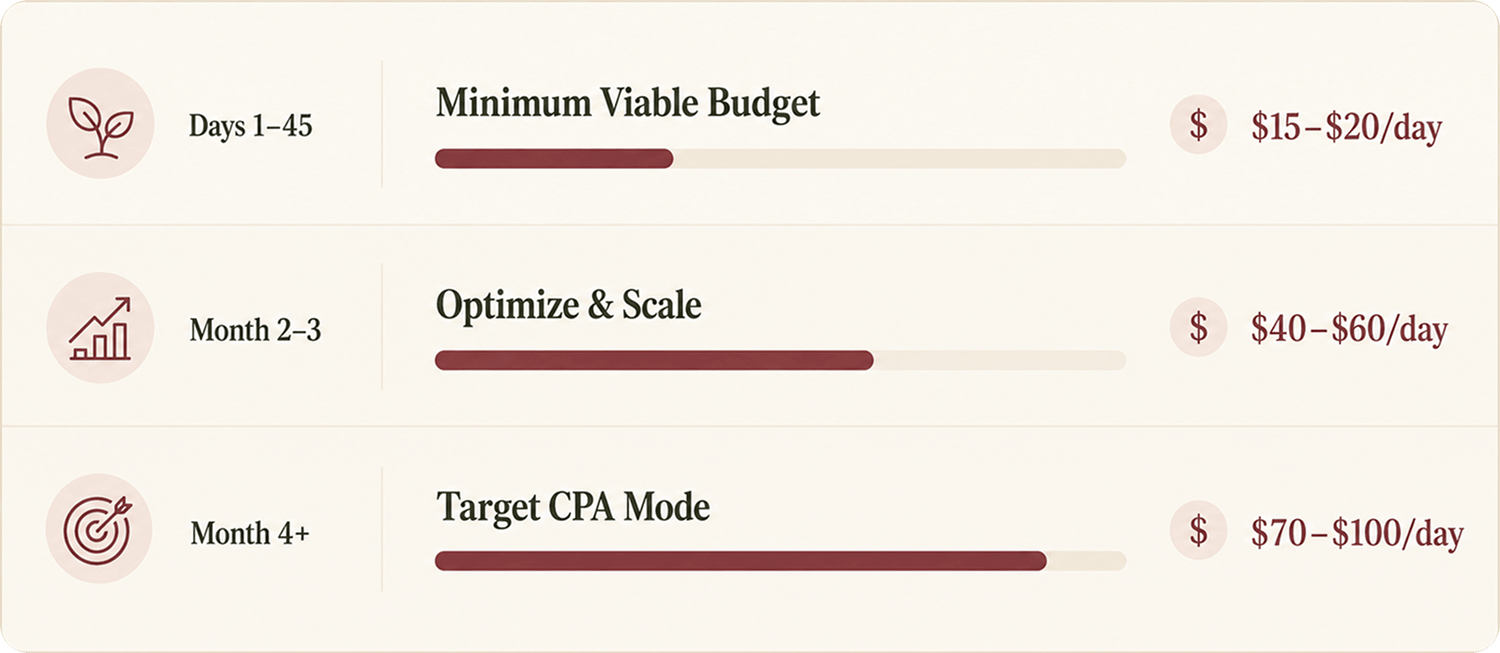
Once your campaign registers 30–50 conversions, transition from Maximize Conversions to Target CPA bidding. Set your initial Target CPA 20–30% above your long-term target to give the algorithm room to optimize without artificial constraints
7.The Compounding Advantage
For salons, the goal of search advertising is not to spend the most — it's to match capital deployment precisely to market dynamics and internal unit economics. A well-structured campaign at $2,500/month consistently outperforms a poorly structured one at $10,000/month.
The compounding effect is real: an account that accumulates 30–50 conversions per month trains Google's algorithm to find more of the exact customer profile that books and stays. Combined with a solid LTV model, a negative keyword infrastructure, service-split campaigns, and mobile-optimized landing pages, paid search becomes exactly what it should be — a predictable, scalable acquisition engine that improves with every dollar spent.