If you've ever run the daydream behind a commission chair — your prices, your hours, your profit — a salon suite makes it unusually reachable. The question that stops most stylists isn't do I want this? It's can I afford it? The honest answer is almost always yes, and with fewer clients than you'd think. You just have to see the real math first.
What a salon suite actually is
A salon suite (or salon studio) is a private, fully-equipped mini-salon inside a larger building that's been divided into individual leasable rooms. Instead of working on commission or renting a chair in an open room, you lease your own private space and run your own independent business inside it.
The building owner or network is your landlord — they provide space, utilities, common areas, and foundational equipment. You're the boss: you set prices, choose hours, sell the retail you believe in, and keep 100% of your profit after a flat rent. That flat-rent structure is the whole game — one predictable number instead of handing a salon 40–60% of every service.
The four salon suite models — and who each fits
Picking the right setup is the first lever on your costs.
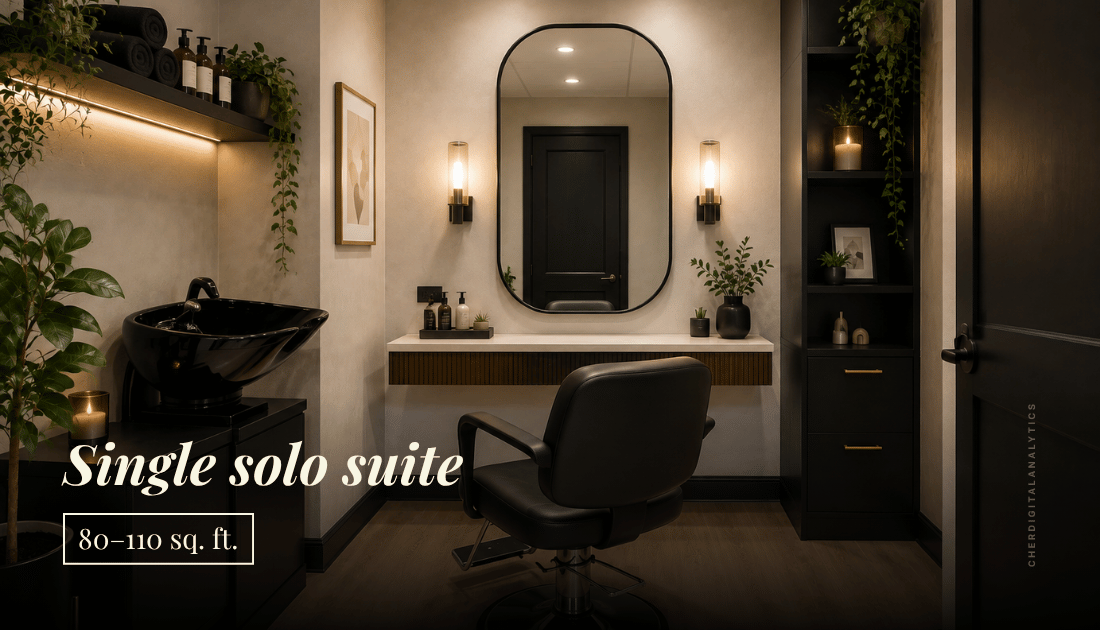
One chair, one bowl, total privacy. Fits established stylists, colorists, estheticians, and lash artists with a loyal book. Maximum control and every dollar of profit — but you carry the full rent alone.
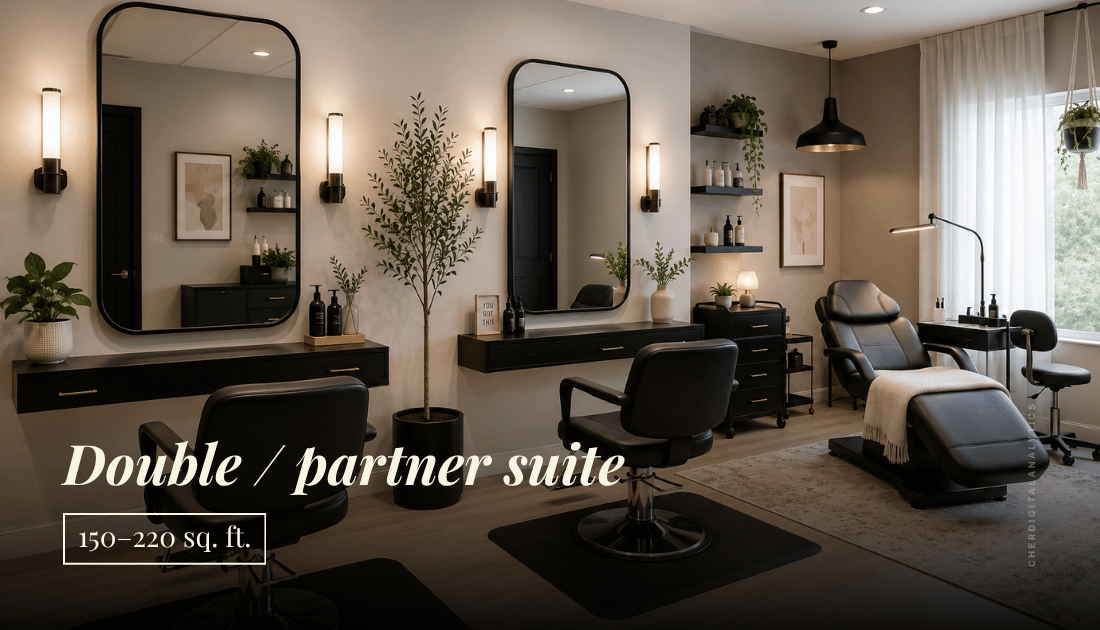
Two pros share a larger room — partners, or complementary services like a stylist plus a lash artist. Rent splits roughly in half; you trade a little solitude for a colleague beside you.
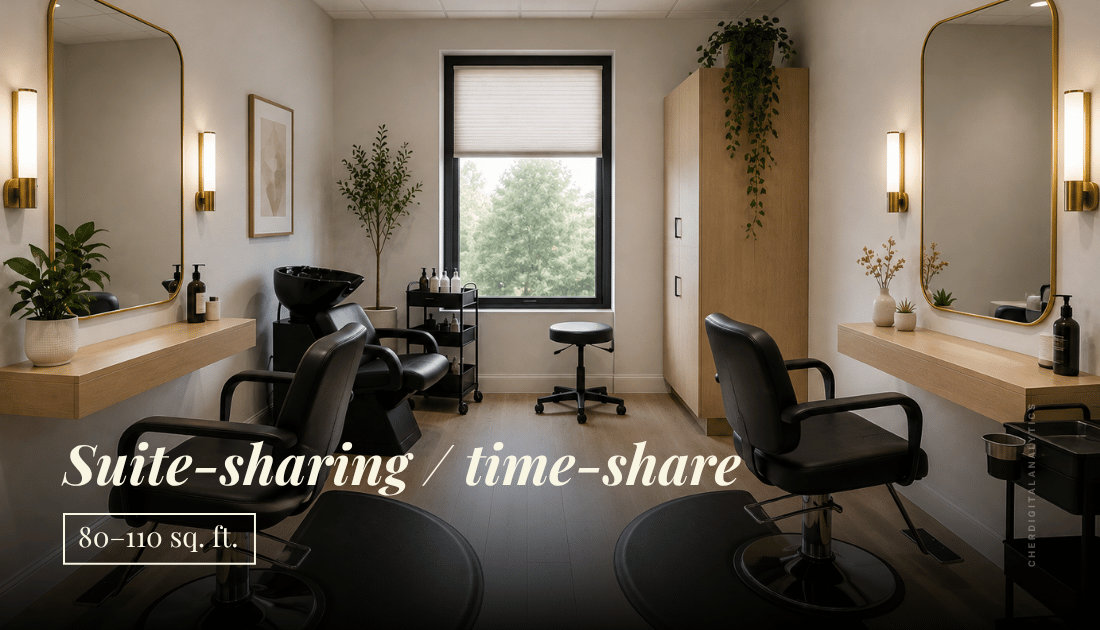
Two or more pros in one room on non-overlapping days. Cuts weekly overhead 30–50% and is the lowest-risk way to test suite ownership — ideal for part-timers, working parents, and anyone still building a book.
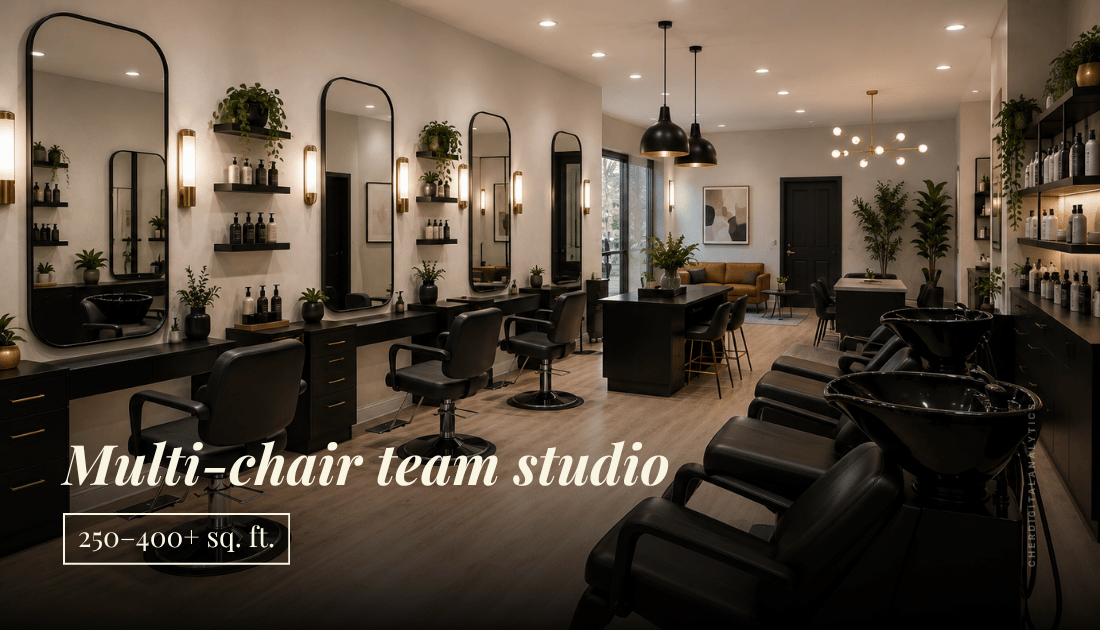
A lead stylist leases a big space and hires associates or sub-leases stations. Higher total lease, but real scale — you earn from your team's production, not just your own two hands.
On the fence financially? A time-share or partner suite lets you enter for a fraction of solo rent and graduate later.
How much does a salon suite cost? Rent by state
Suites run on short, flexible terms built for independent artists — most commonly weekly.
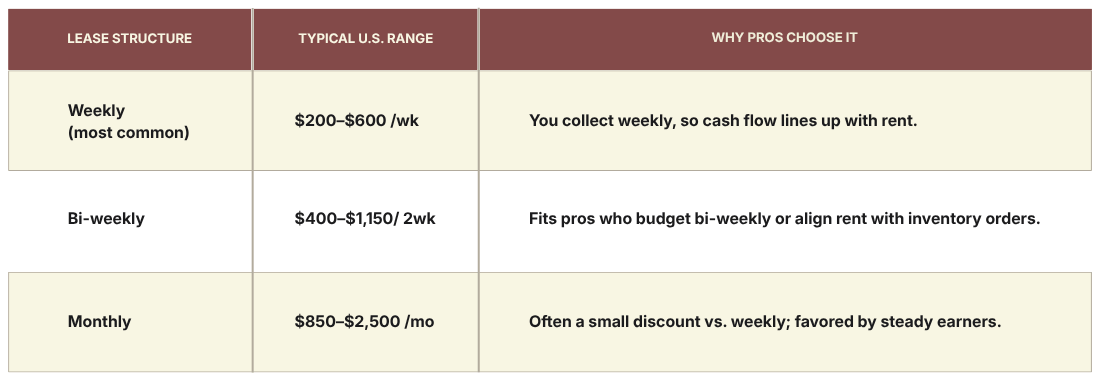
Rent usually covers the essentials: water, electricity, Wi-Fi, laundry, initial equipment, and common-area maintenance.
Where you live changes everything
Geography is the biggest single factor in rent. The U.S. market splits roughly three ways:
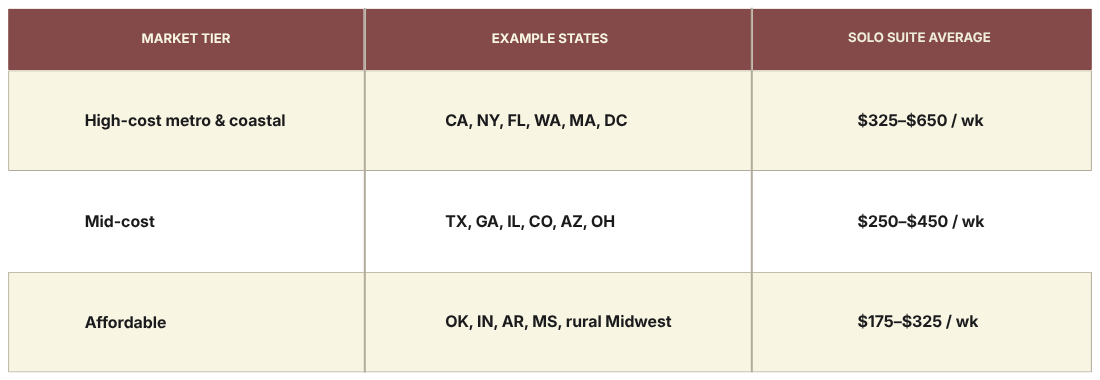
Prime markets like Manhattan or Beverly Hills push past $1,200/week — but with the client price tolerance to match. Don't compare your local rent to a national headline; compare it to what your clients will happily pay per service.
The costs hiding behind the rent
Rent is the number everyone quotes, but your real monthly outflow has two parts.
Fixed costs stay the same whether you see 4 clients or 40: rent (weekly rate × 4.33 weeks/month), liability insurance, booking software, any utilities not bundled in, and marketing.
Variable costs rise with each client: backbar and color supplies, plus the card-processing fee (~2.7%). A handy shorthand is your cost per client — often $10–$15 for color-heavy work, less for a cut or a lash fill.
Add the two together and you have your true monthly cost — which brings us to the only number that really decides this.
The number that matters: your break-even point
Break-even is the client count where revenue exactly covers costs. Below it, you're paying to work. Above it, every client is profit. Each service earns its price minus the supplies and fees it uses — that leftover is your contribution margin. Divide fixed costs by that margin and you get the clients you need each month:
Break-even clients / month = Fixed costs ÷ (Average price − cost per client)
The result surprises almost everyone, because one flat rent covers so much service volume.
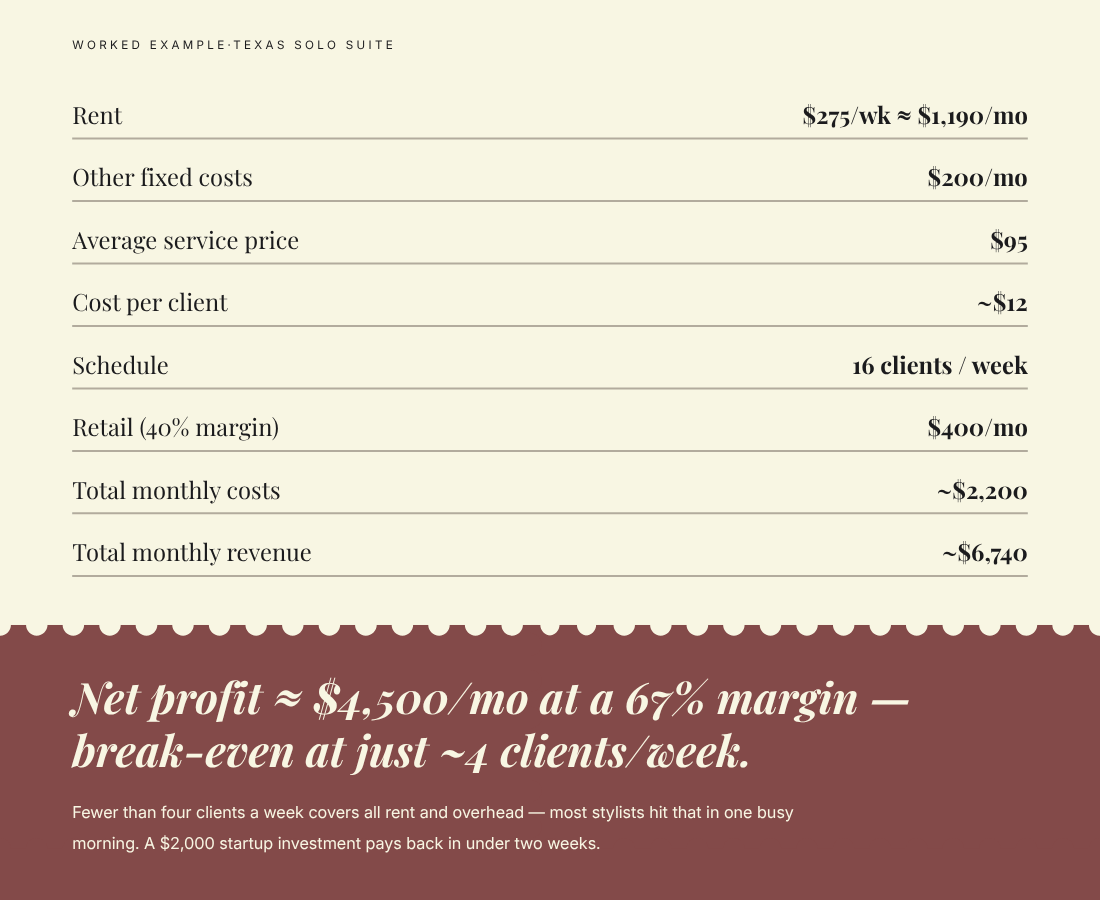
Your numbers will differ — a $60 ticket in a low-cost market or a $180 ticket in Manhattan changes the story. That's exactly why running your own figures beats any benchmark.
The quiet advantage: retail you keep 100% of
In a commission salon, product sales get cut 50% or more. In your own suite, you keep the entire margin — typically 40–50%. It sounds small until it compounds: in the Texas example, $400 in monthly retail added $160 straight to the bottom line without a single extra service hour. Treat retail as a real revenue line and it often adds a car payment's worth of profit a month on top of services.
Three ways to earn more the day you move in
- Bundle and upsell freely. Add scalp treatments, gloss add-ons, or specialty lash services with no manager taking a cut.
- Keep every retail dollar. Curate a small, high-margin shelf of products you genuinely use.
- Cross-promote with neighbors. The stylist and esthetician down the hall are referral partners, not competition.
Don't forget licensing and startup costs
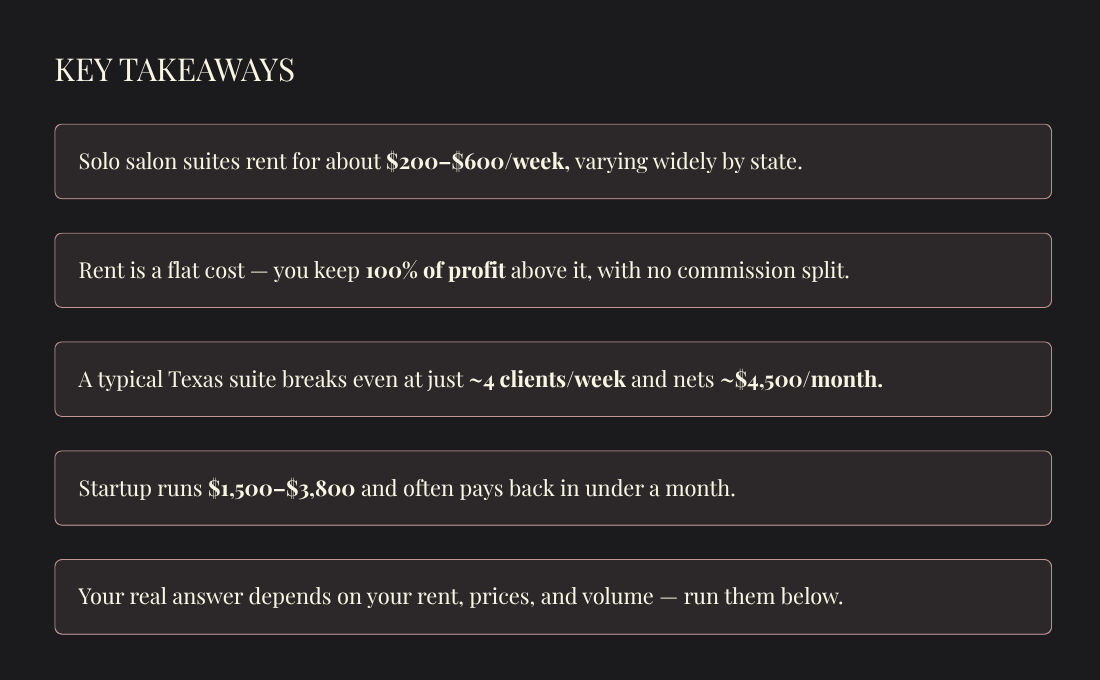
Nearly every state requires two things: your individual professional license and a facility or establishment license (sometimes a booth-rental permit). Fees are modest and vary — roughly $50 in California, closer to $275 initially in Florida, about $60 in New York, each with its own LLC filing costs. Budget a realistic startup range of $1,500–$3,800 depending on your state and how much you put into décor and opening stock. As the Texas example showed, turnkey suites and fast profit tend to pay that back quickly.

Frequently asked questions
How much does a salon suite cost per week?
Most solo salon suites rent for $200–$600 per week. Coastal metros like New York and California average $325–$650 (and exceed $1,200 in prime areas), mid-cost states like Texas average $250–$450, and affordable Midwest markets average $175–$325. Rent usually includes utilities, Wi-Fi, laundry, and common-area maintenance.
How many clients do I need to break even?
Fewer than you'd expect. In a typical Texas suite with $275/week rent and a $95 average service, break-even lands at about four service clients per week. The formula is fixed monthly costs ÷ (average price − cost per client).
Is renting a salon suite worth it?
For an established stylist with a loyal book, usually yes. Because you pay one flat rent instead of a 40–60% commission split, most revenue above break-even becomes profit — often around $4,500/month net at a 67% margin in a typical Texas scenario, with startup costs recovered in under two weeks.
What's included in salon suite rent?
Typically water and electricity, Wi-Fi, laundry, initial equipment like a chair and shampoo bowl, and common-area maintenance. You cover your own supplies, insurance, booking software, and retail inventory.
Does a salon suite make more than a commission salon?
For most stylists with a steady book, yes. A commission salon keeps 40–60% of services and about half of retail. In your own suite you keep 100% of profit after rent and 100% of retail margin, so earnings scale with your work instead of being capped by a split.
How much does it cost to start a salon suite business?
Plan for roughly $1,500–$3,800, covering opening stock, décor, licensing, and lease deposits. Most states also require an individual professional license and a facility/establishment license, with fees that vary by state.
We're a boutique digital marketing studio built exclusively for salon and beauty business owners. We pair data — GA4, Search Console, and clear reporting — with a content-first, AI-search-ready approach, so the clients searching for your services actually find you. If you're launching or growing a suite, let's talk about filling that chair.
This article is for planning and educational purposes and isn't financial or legal advice. Rental figures are U.S. market estimates and vary by location, facility, and lease terms.