
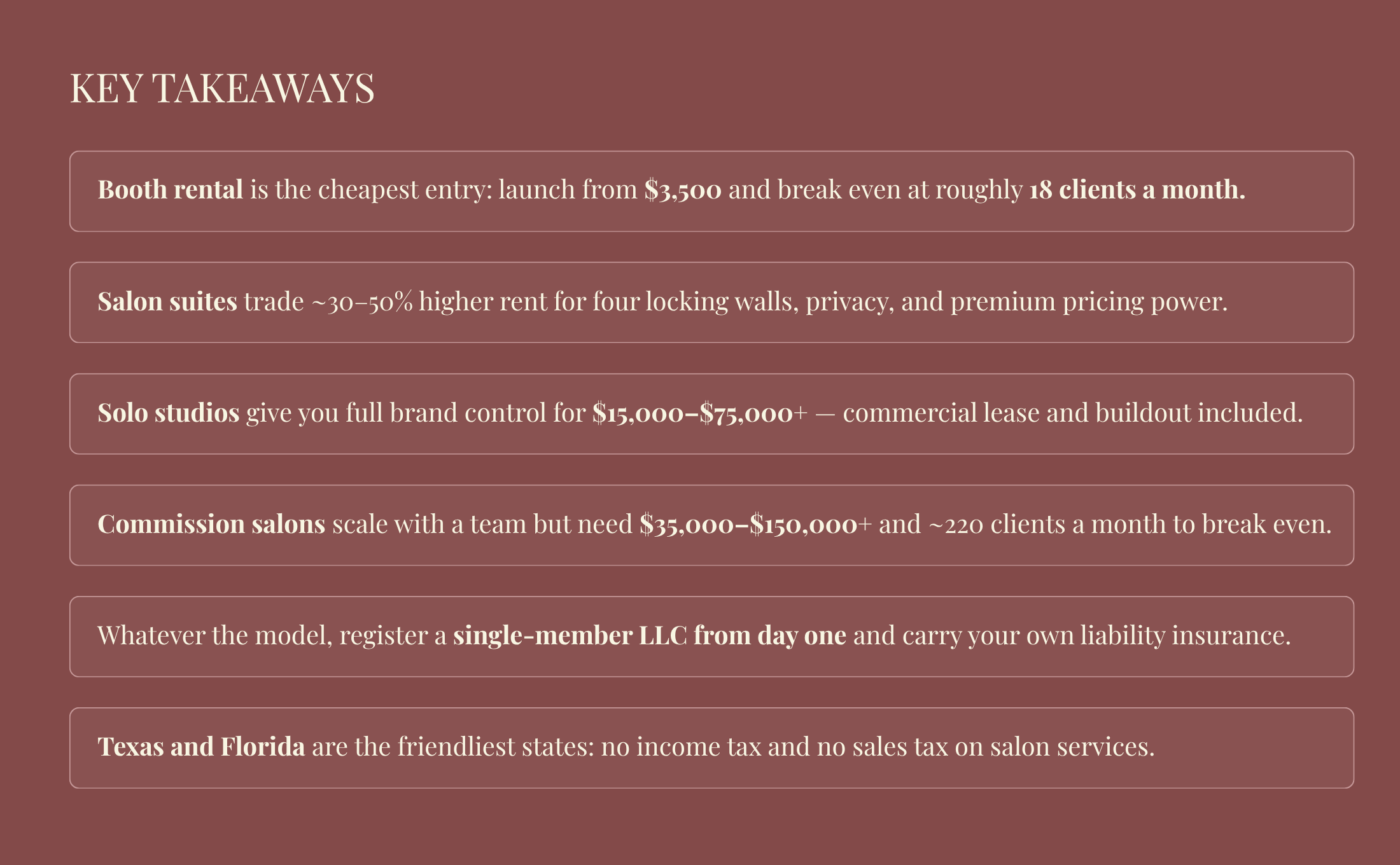
The 4 Salon Business Models at a Glance
Every salon career path in the U.S. falls into one of four ownership structures. The right one depends on three things: how big your existing client book is, how much capital you can invest, and whether you want to work solo or lead a team. Tap a card to jump to the full breakdown.
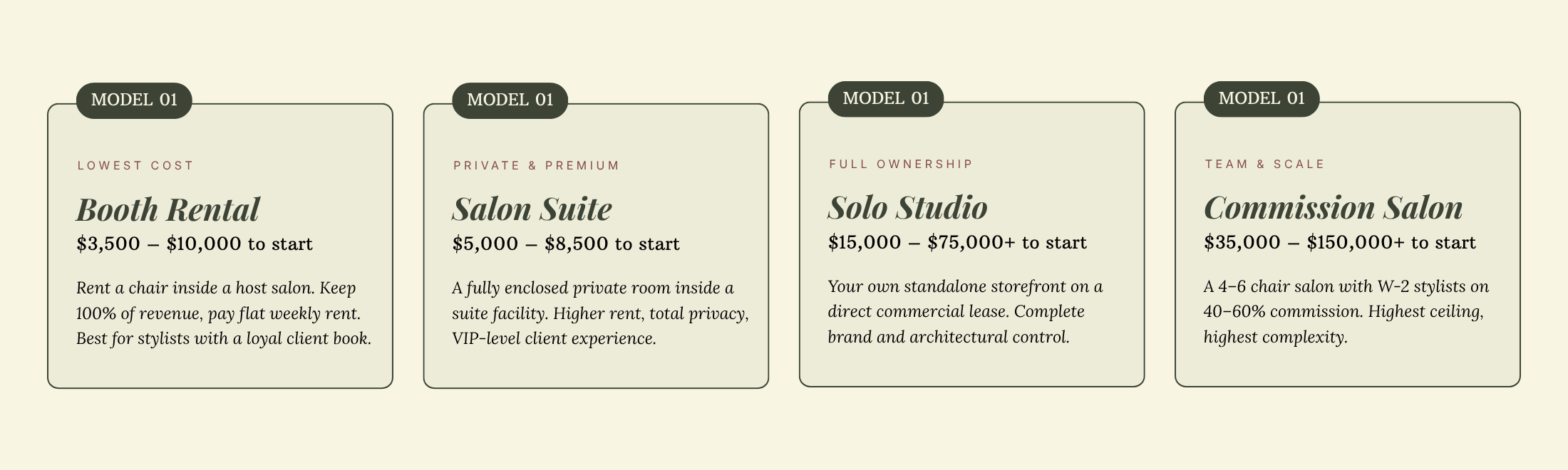
Side-by-side comparison
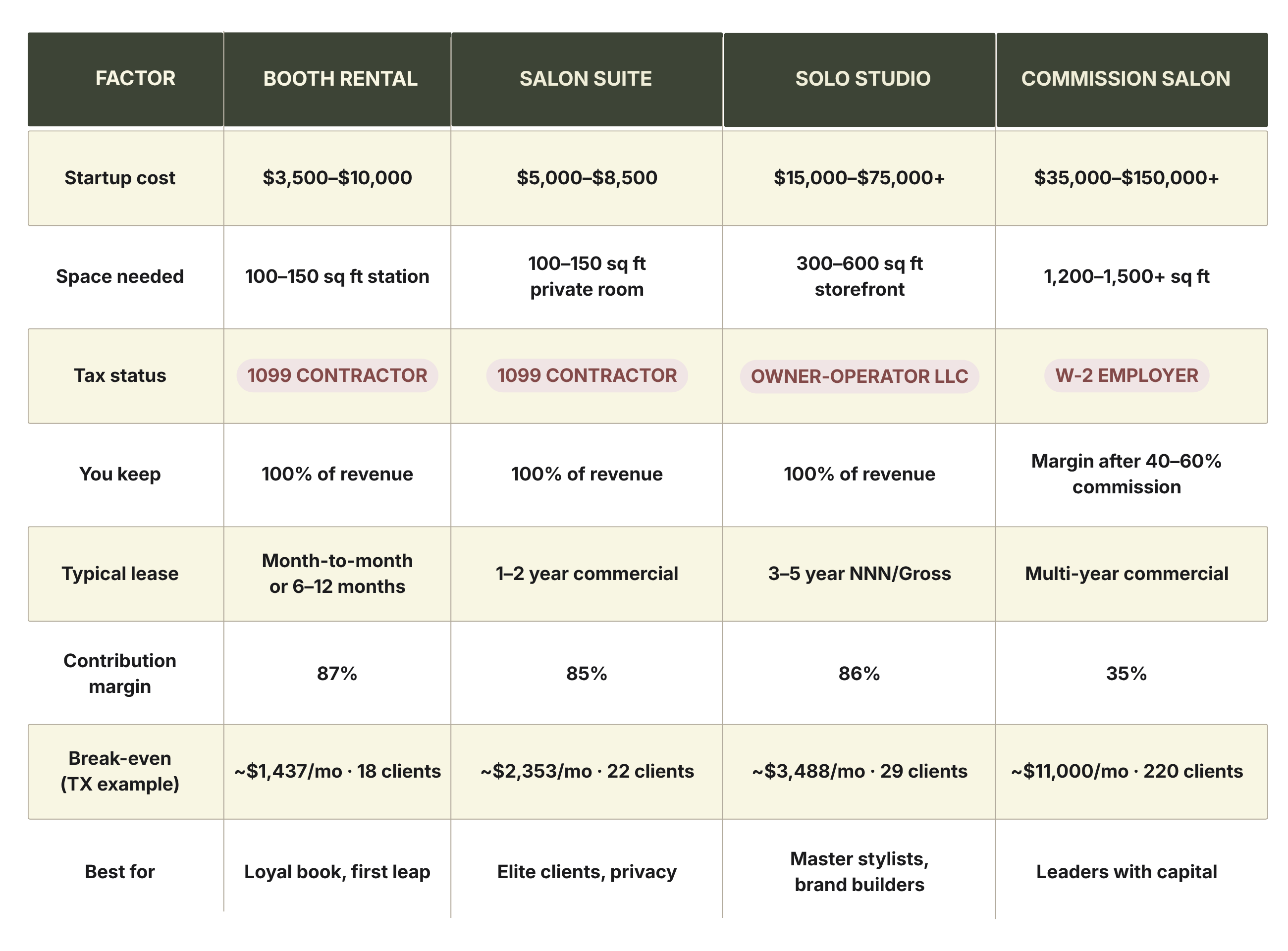
Break-even figures use the Texas case studies detailed in each section below — adjust for your own rent, ticket size, and state in the calculator.
Booth Rental Salon: The $3,500 Launch
Booth rental is the classic first step into salon ownership. Instead of splitting your hard-earned money with a salon owner on commission, you rent a single chair inside an established host salon for a flat, predictable weekly or monthly fee — and keep 100% of your service and retail revenue.

Who should choose booth rental?
- Experienced stylists with a stable, loyal, recurring client book who are tired of commission splits.
- Newly graduated stylists with aggressive local marketing skills and a strong personal network who can fill a chair fast.
How the business works
- Rental agreement: leases run month-to-month or 6–12 months. Rent is fixed regardless of how many clients you see or how much you earn.
- Tax status: booth renters are 1099 independent contractors — fully autonomous business owners. The host salon owner cannot legally dictate your hours, service pricing, product choices, or dress code.
- Location: you need only a 100–150 sq ft station footprint inside an established host salon, ideally in a busy commercial area or main road for walk-in visibility.
What you need to buy
- Station setup: mirror adjustments, ring lights or LED station lighting, and a personal rolling utility cart.
- Equipment: the host provides the chair — you supply blow dryers, flat irons, curling wands, professional shears, clippers, and sanitizing jars.
- Inventory: your own backbar shampoos and conditioners, a chemical color line with developers and foils, mixing bowls, and retail products for client purchase.
Licenses and legal setup
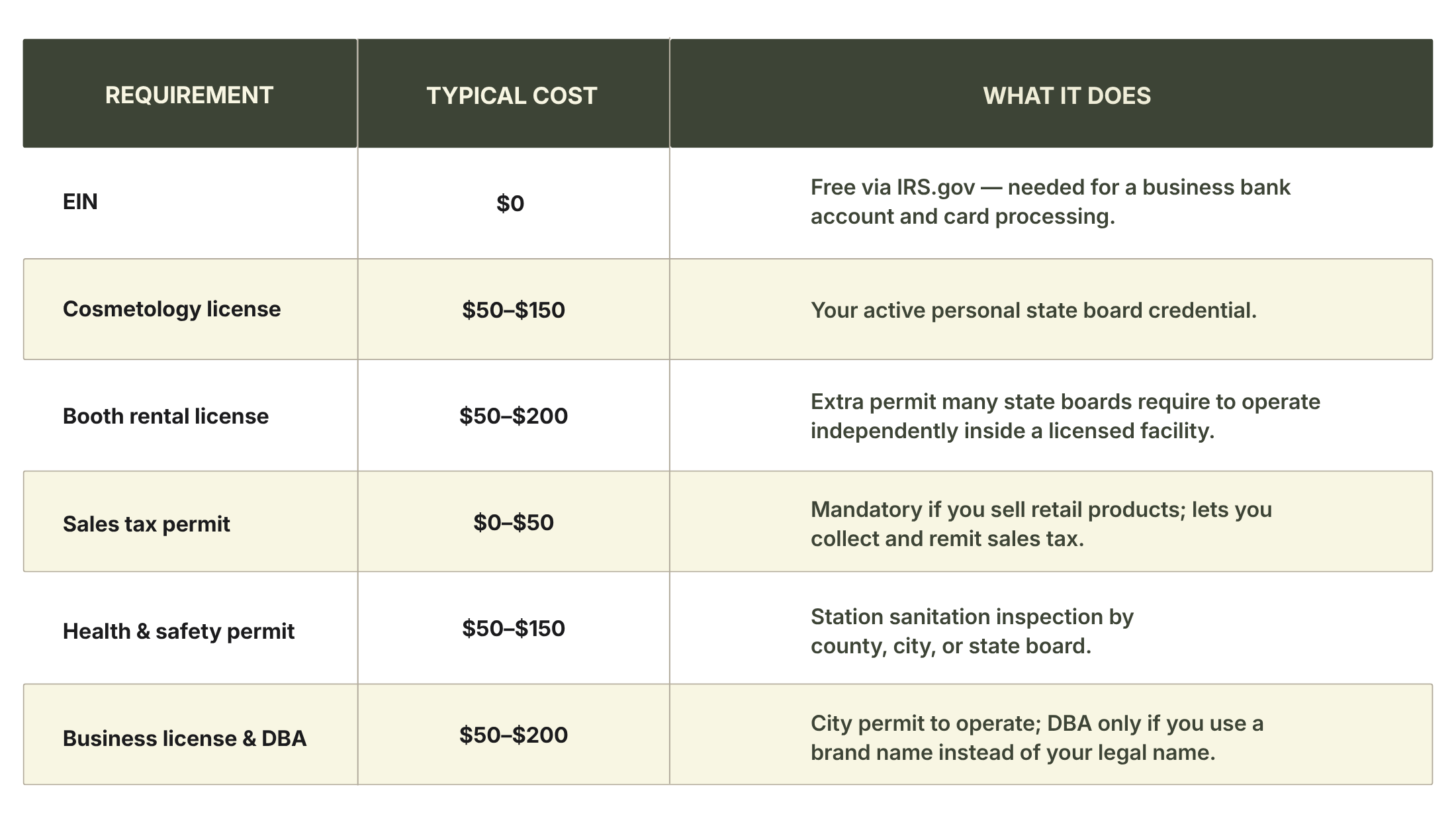
LLC or sole proprietorship?
A single-member LLC is the clear winner for booth renters. It separates your personal assets — savings, home, car — from business liabilities, so if a client sues over an accidental chemical reaction, your personal property is protected. Taxes stay simple: profits pass straight to your personal return on Schedule C. A sole proprietorship is cheaper to start but offers zero liability protection, leaving your personal assets fully exposed.
Booth rental break-even math (Texas example)
Because you pay no staff commissions, variable costs are tiny: about 10% of revenue for product replenishment and 3% for card processing — a 13% variable cost and an 87% contribution margin.
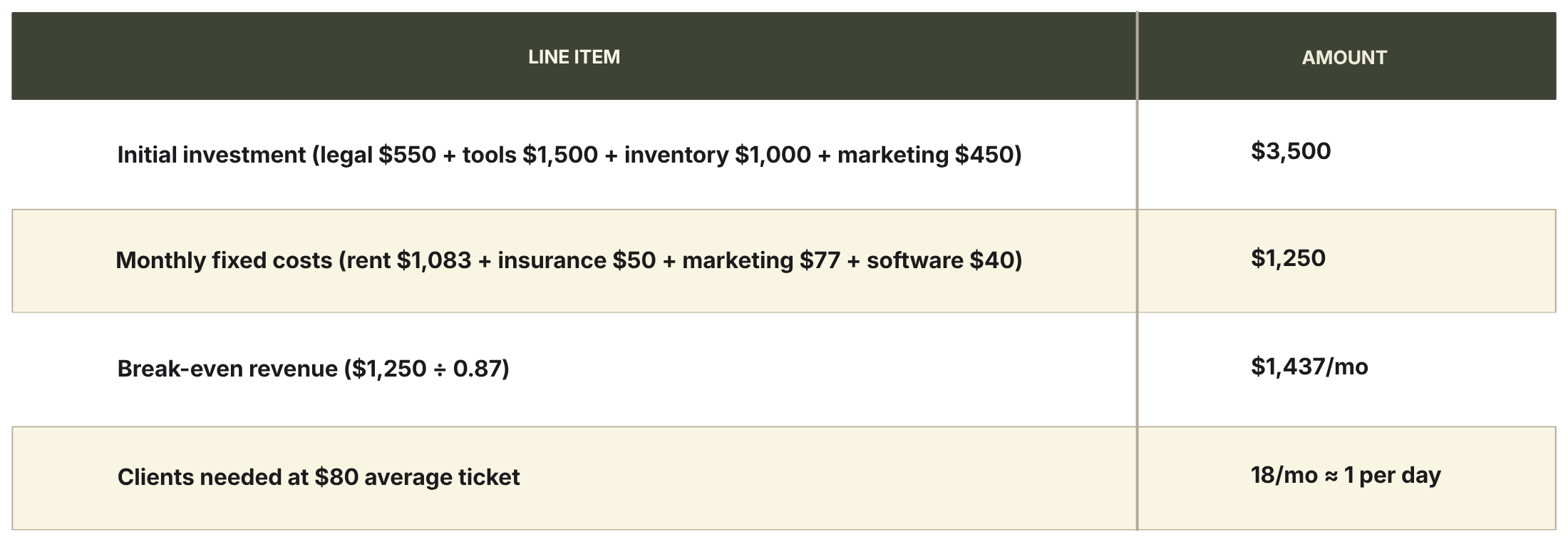
One client a day covers your costs — everything beyond that is profit. That is why booth rental is the safest first leap into independence.
Salon Suite: Privacy That Pays for Itself
A salon suite is a completely enclosed private room — four locking walls — inside a purpose-built suite facility. Compared with booth rental's open floor, a suite gives your clients an exclusive, VIP experience, and gives you room to charge for it. Like booth renters, suite renters keep 100% of service and retail revenue.

Two ways in
- Independent suite renter: an elite beauty professional with a high-paying, established client base who wants absolute privacy and premium positioning.
- Suite developer (owner/landlord): a real estate investor dividing 3,000–6,000 sq ft into 15–30 private luxury suites — a $250,000–$500,000+ buildout with plumbing to every room.
How the business works
- Lease: commercial terms of 1–2 years are standard. Because structural privacy and premium infrastructure come included, rent runs 30–50% higher than a booth.
- Tax status: strictly 1099 independent contractor — you own your mini-salon, set your hours and prices, and curate your own retail brands.
- Location: premium demographics beat raw foot traffic. Look for upscale neighborhoods, easy highway access, and secure parking.
Setup, licensing, and insurance
- Suite buildout: tailored decor, premium client mirrors, architectural LED lighting, and a client beverage station.
- Equipment: your own hydraulic styling chair, rolling carts, shears, dryers, irons, clippers, and sterilization storage.
- Licenses: EIN ($0), cosmetology license, a salon suite / shop license ($100–$300) recognizing your room as a compliant micro-salon, and a sales tax permit for retail.
- Entity: a single-member LLC is essential to shield personal assets from chemical or injury claims.
Salon suite break-even math (Texas example)
High-end treatments push product costs slightly above booth rental — about 12% replenishment plus 3% processing, for a 15% variable cost and an 85% contribution margin.
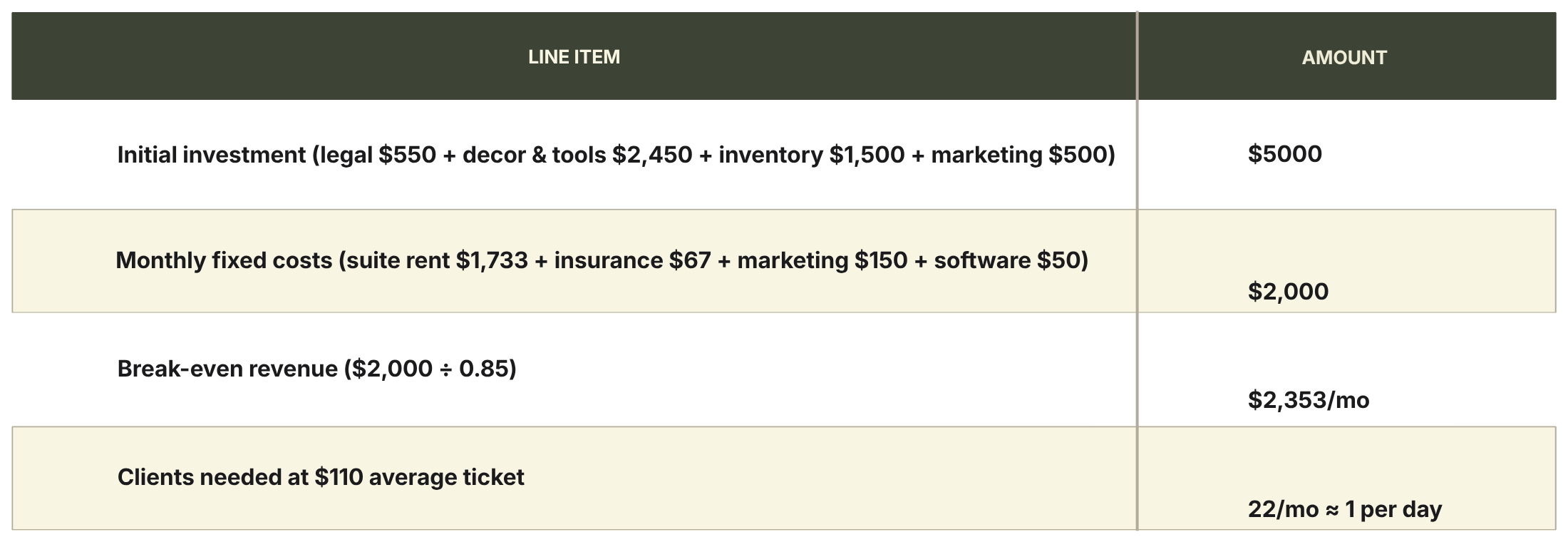
Notice the leverage: the suite costs $750/month more than a booth, but the private setting justifies a $110 ticket instead of $80 — so break-even still lands at about one client per day.
Solo Studio Salon: Your Name on the Door
A solo studio is a standalone retail storefront or commercial micro-unit leased directly from a commercial landlord — no shared hallways, lobbies, or other renters. You capture 100% of service and retail margins while controlling every inch of the brand environment, client journey, and operating rules.

Who should choose a solo studio?
Master stylists, experienced solo practitioners, and luxury service providers who want absolute creative autonomy and standalone brand authority. One styling chair is sufficient — two at most if you use an assistant or want to prep a second client. More than two creates space constraints and unnecessary overhead.
The commercial reality
- Lease: a direct commercial lease, typically 3–5 years, NNN or Gross. Rent is a fixed obligation regardless of your monthly volume.
- Zoning: the building must be zoned for personal service shops.
- Plumbing: a dedicated commercial connection for the shampoo basin and point-of-use water heaters is mandatory.
- Electrical: plan for a 100–200 AMP panel so dryers, processing lights, and HVAC can run simultaneously without trips.
- Location: high-visibility street fronts, walkable urban districts, or neighborhood retail strips with stable parking.
Buildout, equipment, and inventory
- Leasehold buildout: trench plumbing for backwash bowls, commercial water heaters, color-correct overhead track lighting, and waterproof commercial flooring.
- Furniture & equipment: hydraulic styling chair, luxury backwash unit, vanity mirror station, waiting seating, reception cabinetry, and rolling color trolleys.
- Inventory: full backbar and chemical stock, branded capes and towels, and stocked retail shelves for homecare sales.
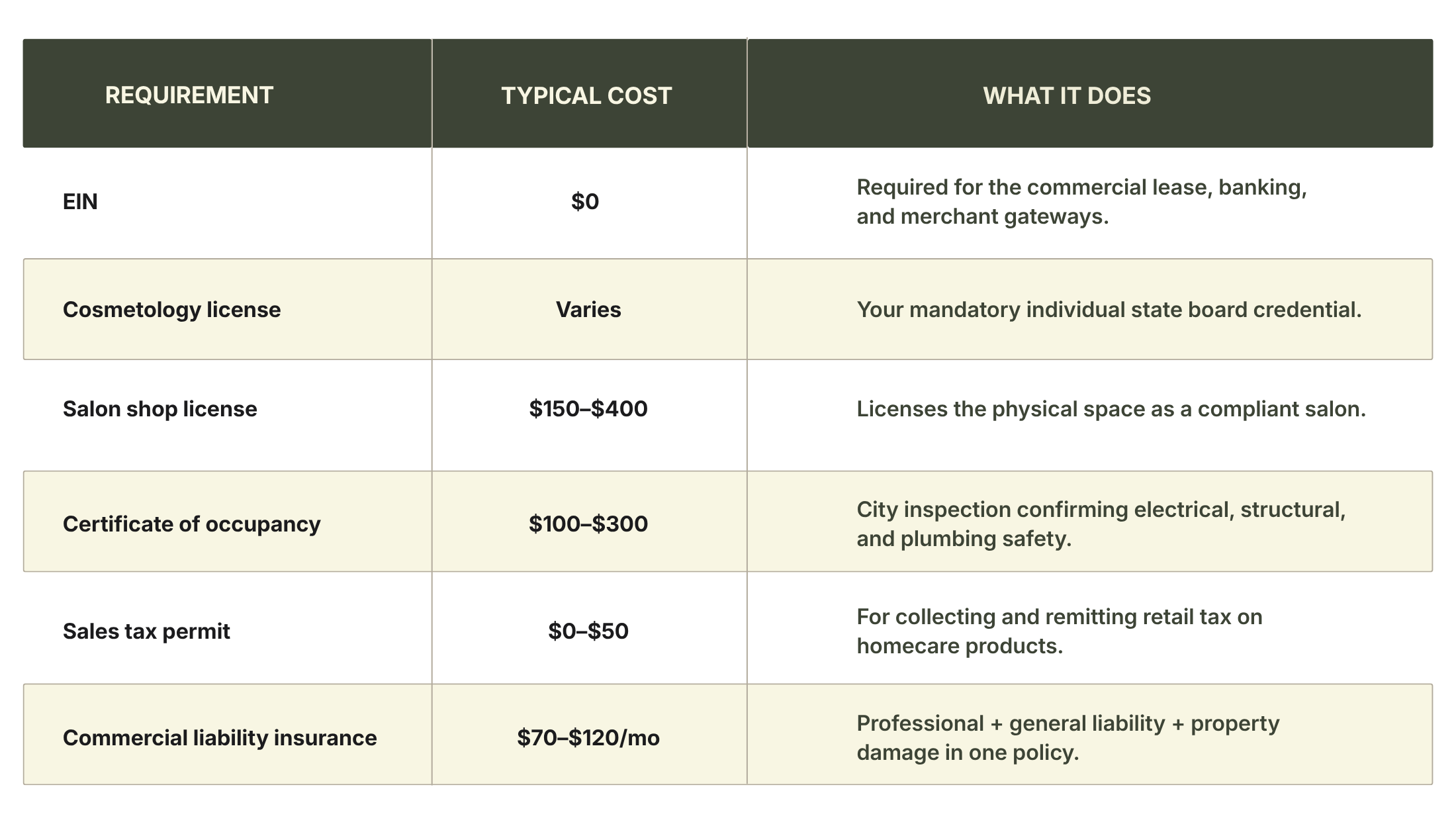
Licenses and legal setup
Solo studio break-even math (Texas example)
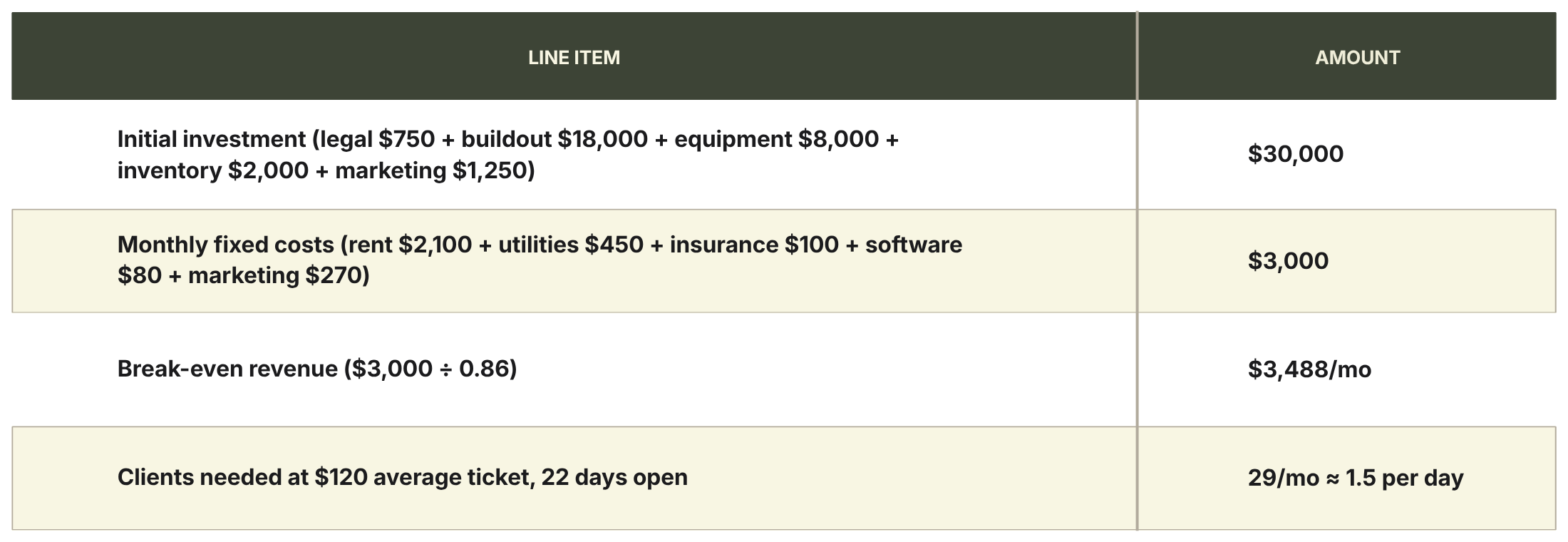
Boutique product replenishment runs about 11% of revenue plus 3% processing — a 14% variable cost and an 86% contribution margin. The difference is the fixed-cost base: you carry rent and utilities on a standalone building.
Commission-Based Salon: Building a Team That Scales
A commission salon flips the equation: instead of working every chair yourself, you hire 3–4 stylists and earn a margin on everything they produce. It is the only model on this list that scales beyond your own two hands — and the only one that makes you an employer.

Who should choose this model?
Beginners or experienced stylists with strong leadership skills, the ability to manage a team, and higher initial capital. A good starting structure for new-graduate hires is a 40% base commission plus a 10% bonus on product sales, with rates ranging up to 60% for proven producers.
How the business works
- Tax status: commission stylists are almost always W-2 employees, which legally allows you to set and manage their schedules — something you can never do with 1099 renters.
- Space: plan for 4–6 styling chairs plus one private beauty room, a minimum of 1,200–1,500 sq ft in a popular shopping center or busy main road.
- Buildout: flooring, plumbing for backwash units, high-wattage electrical for dryers, specialized lighting, styling stations, reception, and waiting area furniture.
Licenses, entity, and insurance
- EIN ($0): essential for running W-2 payroll.
- Cosmetology establishment license ($100–$300): the primary state board license for the facility.
- Sales tax permit ($0–$50), health permit ($50–$250), business license & CO ($150–$500).
- Entity: single-member LLC to start; a multi-member LLC if you open with a partner (files Form 1065); elect S-Corp status once profits consistently hit $60k–$100k+ to cut the 15.3% self-employment tax. Avoid a C-Corp — double taxation makes it unsuitable for an early-stage salon.
- Insurance: for a 4–6 chair chemical-service salon, budget $50–$150/month for professional + general liability.
Commission salon break-even math (Texas example)
This is where team economics bite. A 50% commission plus ~4.5% payroll tax burden and ~10.5% product cost puts variable costs at 65% of revenue — leaving a 35% contribution margin. Fixed costs must be covered by a much larger revenue base.
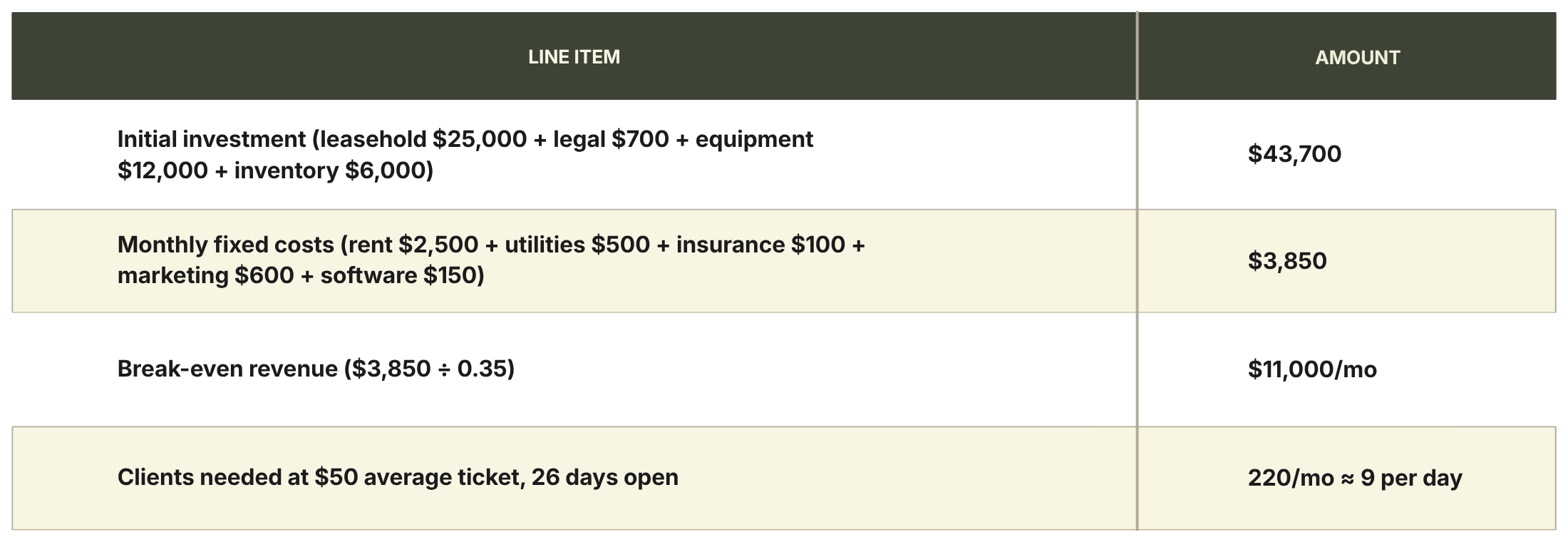
Nine clients a day across a 4–6 chair floor is very achievable for a well-marketed salon — but it demands consistent bookings from day one, which is why marketing budget ($600/month in this example) is not optional in this model.
Salon Break-Even Calculator
Pick a model preset, then plug in your own rent, ticket size, and costs. The math follows the standard formula: break-even revenue = monthly fixed costs ÷ contribution margin ratio, where the margin ratio is 100% minus your variable cost percentage.
Run your numbers
Presets load the Texas case-study figures for each model — every field stays editable.
Estimates only — actual costs vary by market, lease terms, and state fees. See the state table below for legal-setup baselines.
Salon Legal & Tax Setup Costs by State
Setup costs below combine the average LLC filing fee, model-specific licensing, and standard local permits for each state. Search for your state or filter by tax profile. Two patterns matter most: Texas and Florida pair no income tax with no service tax, while states marked with a service tax (Connecticut, New Jersey, New Mexico, Hawaii and others) tax your services directly and add paperwork.
| State | Booth Rental | Salon Suite | Solo Studio | Commission | Service Tax | Income Tax |
|---|
California adds an $800/year minimum franchise tax on top of filing fees. New York's 4.5% service tax applies in NYC. Washington levies B&O tax on gross receipts instead of income tax.
Which Salon Model Should You Choose?
Strip away the details and the decision comes down to your client book and your capital:
- Loyal book, limited savings → Booth rental. One client a day breaks you even, and month-to-month leases keep the exit door open.
- Premium clientele who value privacy → Salon suite. The 30–50% rent premium is funded by the higher ticket a private room commands.
- Established brand, ready for real estate → Solo studio. A 3–5 year lease is a commitment, but nobody shares your walls, your rules, or your margins.
- Leadership skills and $40k+ capital → Commission salon. The only model where revenue grows while you sleep — if you can keep nine chairs' worth of clients coming through the door.
Many independent careers move through these models in order: build a book in a booth, upgrade to a suite as prices rise, then open a studio or team salon once the brand carries itself.
Salon Startup FAQ
How much does it cost to start a salon business?
It depends entirely on the model: booth rental runs $3,500–$10,000, a salon suite $5,000–$8,500 for the renter, a solo studio $15,000–$75,000+ (buildout is the biggest line), and a commission salon $35,000–$150,000+.
What is the cheapest way to start a salon business?
Booth rental. With basic tools, opening backbar products, standard booking software, and minimum state licensing, you can launch for about $3,500 — and break even at roughly 18 clients per month at an $80 average ticket.
Are booth renters employees or independent contractors?
Booth and suite renters are 1099 independent contractors: the host cannot dictate hours, pricing, products, or dress code. Commission salon stylists are almost always W-2 employees, which is what lets the owner set schedules legally.
Do I need an LLC to rent a booth?
Not always legally required, but strongly recommended from day one. A single-member LLC shields your personal assets from claims like chemical reactions, while profits still pass through to your personal return on Schedule C. A sole proprietorship offers zero liability protection.
Which states are best for opening a salon?
Texas and Florida lead: no state income tax and no sales tax on salon services. California and New York offer premium demographics that support higher pricing despite heavier compliance. Service-tax states like New Jersey and New Mexico add administrative burden on every appointment.
When should I switch my LLC to S-Corp status?
Once net profit consistently reaches roughly $60,000–$100,000+ per year. An S-Corp election lets you split income into salary plus distributions, reducing the 15.3% self-employment tax — at the cost of extra administrative work.
Does the host salon's insurance cover me?
No. As an independent renter you must carry your own professional liability (treatment injuries) and general liability (station accidents) coverage — typically $30–$70/month for a booth, $40–$80 for a suite, and $70–$120 for a standalone studio.